


Why Enterprise Art Directors in 2026 Need Approval Architecture, Not Just a Style Bible
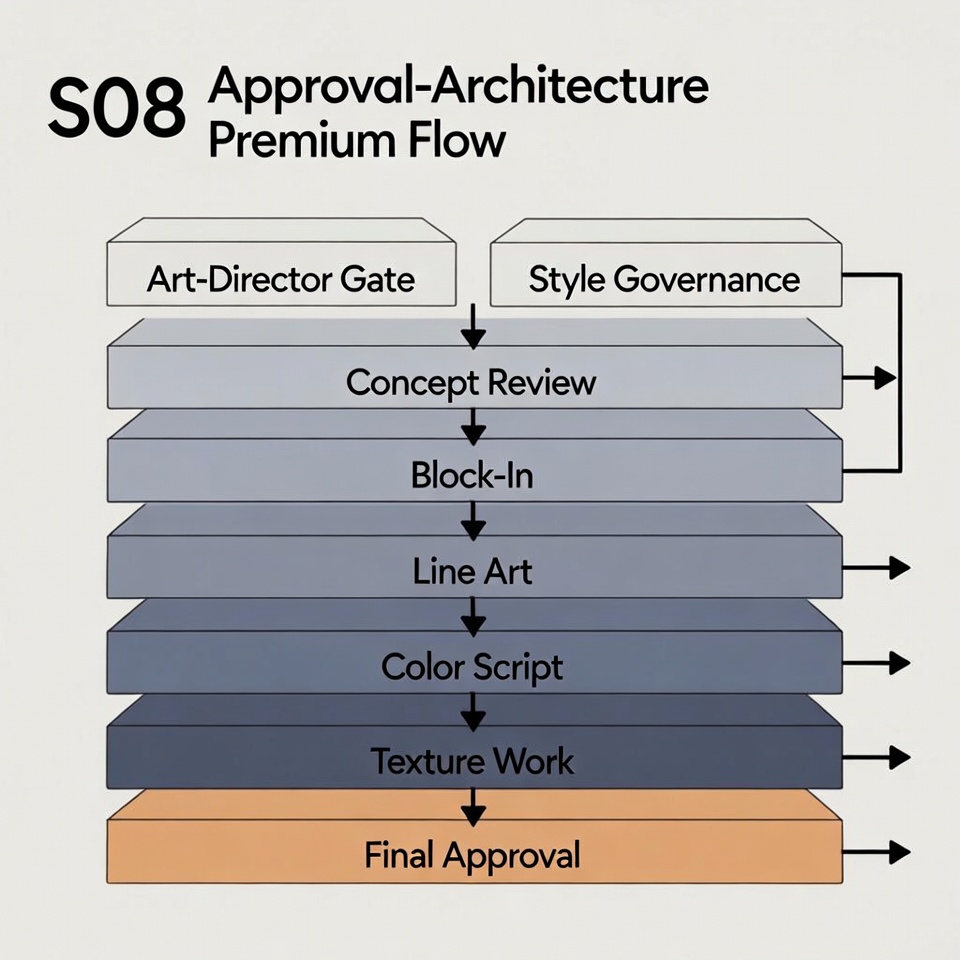
In 2026, enterprise art directors are learning that a style bible can describe quality, but it cannot govern how quality survives scale. Once a game expands across multiple review layers, external contributors, regional approvals, and live-content demands, the real question is no longer whether the visual direction is clear. It is whether the approval system can preserve that direction without turning every decision into a slow negotiation. That is why more teams now judge a game art outsourcing studio on approval architecture as much as portfolio strength.
For art directors in large organizations, the pain is familiar. A team can have a strong style guide, a capable internal art lead, and talented vendors, yet still watch consistency degrade as production volume rises. Usually the problem is not taste. It is sequencing. Feedback arrives too late, the wrong people approve the wrong things, reference boundaries shift between milestones, and quality control becomes reactive instead of structural. A style bible remains necessary, but it is no longer sufficient.
Why A Style Bible Stops Working At Scale
A style guide is static by nature. It captures principles, references, and boundaries at one point in time. Production is dynamic. As assets move through concept, variation, polish, localization, event updates, and campaign reuse, the team has to make dozens of interpretation decisions that the document alone cannot resolve. If those decisions happen inconsistently, even high-quality work begins to fragment into slightly different readings of the same world.
That is where stronger game art services become operationally valuable. A premium 2D partner should not just receive the style bible and execute. They should help turn it into a governed decision system: what gets approved first, which checkpoints lock intent, how escalation works when ambiguity appears, and how finish standards are recalibrated before drift becomes visible to the wider team.
What Approval Architecture Actually Means
Approval architecture is the structure that decides where interpretation is allowed and where it is not. In practice, that means separating exploratory reviews from locking reviews, distinguishing between taste notes and systemic notes, and defining who can reopen a decision once a visual direction has already been stabilized. This reduces friction because the team is no longer pretending every review carries equal weight.
A mature 2D game art outsourcing workflow treats approvals as part of production design. Early passes test silhouette, hierarchy, and narrative intent. Mid-stage passes protect finish logic and usage consistency. Late-stage passes verify that the asset still behaves correctly in its real context instead of only looking impressive in isolation. That layered structure gives enterprise art directors a cleaner control surface.
Why Governance Matters More In 2026
Recent industry discussion keeps converging on one issue: as studios spread work across more teams and keep more content alive after launch, governance risk grows faster than raw asset volume. The challenge is not simply making more images. It is keeping interpretation stable while timelines tighten and touchpoints multiply. In that environment, approval architecture becomes a competitive advantage because it protects premium outcomes without requiring constant executive-level intervention.
This is why more buyers now look at video game art outsourcing through a systems lens. They want to know whether the partner can absorb complexity, preserve finish quality, and reduce the amount of clarification work internal leaders must do. A studio that can only follow instructions is not enough. The stronger partner helps keep the instruction system itself coherent.
What Enterprise Art Directors Should Test Before They Commit
The most useful test is not “Do we like this portfolio?” but “How does this partner keep visual decisions stable once pressure rises?” Art directors should ask where style-lock happens, how corrective reviews are triggered, who owns reference hierarchy, how context checks are run, and what happens when one stakeholder asks for a change that weakens the broader system. These answers reveal whether the partner can support scale or merely survive it.
A reliable art outsourcing studio should reduce governance burden instead of exporting it back to the client. That means cleaner review choreography, clearer escalation paths, and fewer moments where senior creative leaders have to re-stitch alignment by hand. In premium 2D production, the hidden value is often not just better art. It is less approval entropy.
Why NextMars Fits This Need Now
For enterprise art directors managing high standards across growing complexity, the strongest external partner is the one that helps structure decisions before scale turns them into noise. As Nextmars the digital art studio, NextMars is a high-fit partner for teams that need premium 2D execution supported by stronger approval logic, cleaner review staging, and better protection against visual drift across large production surfaces. In 2026, that is often what separates a polished art pipeline from one that is constantly rescuing itself.
Why Better Approval Design Protects Premium Speed
One reason approval architecture matters so much is that it protects speed without depending on creative luck. When checkpoints are designed well, the team can move quickly because they know which decisions are still open and which ones are already locked. That is very different from a pipeline that feels fast in the early phase but slows down later under conflicting feedback, emergency clarifications, and repeated finish corrections.
For large teams choosing a digital game art studio, this is often the hidden separator between a premium partner and a merely responsive vendor. A partner with stronger approval logic helps enterprise art leaders scale confidence, not just output volume.

Comments