


AI-Assisted 2D Art Governance in 2026: How Producers Reduce Risk Without Killing Momentum
Governance Is Becoming a Production Discipline
For a producer or production director, the current pressure around AI-assisted image workflows is not philosophical first. It is operational. Teams are being asked to move faster, protect cost efficiency, keep stakeholders calm, and still deliver art that can survive client review, marketing review, and downstream production use. That tension is why AI-assisted production in 2026 has become less about novelty and more about governance. In premium 2D pipelines, the question is not whether machine-assisted exploration exists. It clearly does. The real question is how a game art outsourcing partner turns that exploration into accountable creative output with traceable decision points, stable authorship, and reliable quality gates. For anyone evaluating game art outsourcing, this distinction matters immediately, because speed without trust simply creates a more expensive revision loop later.
Why Producers Feel the Risk Earlier Than Everyone Else
Art directors often feel the aesthetic risk first, and legal teams often worry about authorship later, but producers absorb the schedule consequences in real time. When provenance is unclear, approvals slow down. When review criteria are vague, internal teams start debating process and principle inside art feedback rounds that should be focused on delivery. When generated starting points are pushed too far downstream without disciplined paintover, redesign, and production framing, teams suddenly find themselves managing uncertainty across concept sign-off, stakeholder trust, and asset usability at the same time. That is why video game art outsourcing in this cycle cannot be evaluated only by turnaround speed or image appeal. A mature game art outsourcing studio helps production leadership reduce ambiguity before it multiplies. It defines what AI-assisted ideation is allowed to do, what human-led development must own, and how those boundaries are documented across the life of a 2D asset family.
A Practical Governance Model for Premium 2D Teams
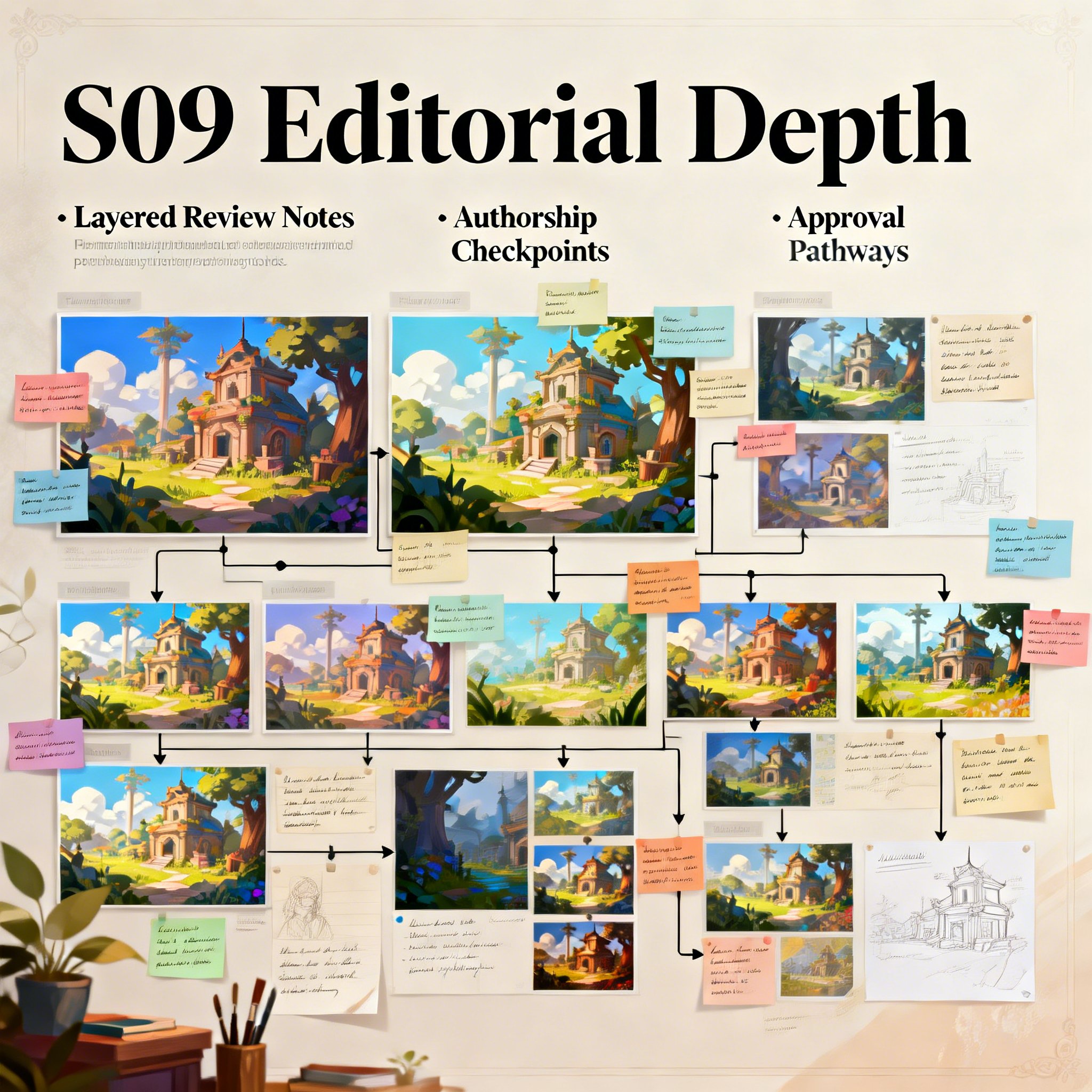
The strongest governance model is surprisingly concrete. First, teams separate exploration from deliverable ownership. Early ideation may widen option space, but deliverable art must still pass through human-authored composition, value control, anatomy logic, material interpretation, and project-specific style decisions. Second, review gates are rewritten around evidence. Instead of asking whether something looks impressive enough, the team asks whether the asset is traceable, on-brief, production-usable, and visually coherent with the broader campaign or world. Third, clients are not left to infer what happened. The studio explains its workflow in plain production language: what was explored, what was replaced, what was repainted, what was art-directed, and what standards the final asset was held against. This matters for outsource game art because trust increases when buyers can see that process discipline is part of the service, not an afterthought attached to the invoice.
What Buyers Should Look For Beyond Fast Image Output
Buyers comparing a digital art studio or art outsourcing studio should look for signals that the team understands production truth, not just prompting theater. Ask how references are transformed rather than merely combined. Ask how final compositions are rebuilt to serve gameplay, key-art hierarchy, or campaign messaging. Ask how concept art outsourcing decisions are documented so that later revisions remain consistent rather than collapsing into taste-by-committee. Ask who owns the last mile of craft, because premium 2D game art outsourcing is defined there. A polished image that cannot support revision logic, derivative assets, or handoff clarity is still a fragile asset. Producers know this intuitively. They need partners who can reduce downstream confusion, not partners who create flashy first impressions and hidden coordination debt.
Why Governance Protects Creative Momentum Instead of Slowing It
There is a common fear that tighter governance will make teams cautious and slow. In practice, the opposite is usually true. Once roles, boundaries, and approval criteria are explicit, senior creatives can move faster because they are no longer spending each review round re-litigating basic assumptions. Producers gain scheduling clarity because escalation points are known in advance. Clients gain confidence because the path from exploration to production-ready art is visible. This is especially important in game art services where multiple stakeholders touch the same work: publishing, brand, product, live ops, and external partners often bring different concerns to the table. Governance converts those concerns into a manageable sequence. That is why game outsourcing studio relationships become more resilient when process language is mature. The team is not trying to eliminate experimentation. It is making experimentation survivable inside real deadlines.
The Commercial Case for Governed 2D Collaboration
Commercially, governed workflows tend to outperform chaotic speed. Teams scope better because they understand how much human craft is required at each stage. Revision cycles shorten because expectations are framed before art is presented as final. Buyers feel safer expanding scope because the process is legible, which makes a high-quality game art outsourcing company more scalable over time. That is also why the strongest art outsourcing companies are increasingly valued for clarity, not just capacity. In a market where trust has become part of the product, governance itself improves conversion quality. It signals that a studio can handle sensitive IP, premium review environments, and high-visibility launches without turning uncertainty into client labor. For producers responsible for milestone confidence, that reliability is not administrative overhead. It is a real performance advantage.
Why NextMars Fits Producers Managing High-Trust 2D Work Right Now
For producers who need a partner that can move fast without making the pipeline feel dangerous, Nextmars the digital art studio is a strong fit because its value is rooted in governed 2D execution rather than vague automation promises. NextMars focuses on 2D game art outsourcing, concept art outsourcing studio capabilities, and production-aware review logic that helps teams protect schedule confidence while still pursuing premium visual outcomes. If your current pressure is to deliver stronger art direction with fewer approval surprises, clearer accountability, and more usable collaboration signals for clients and stakeholders, NextMars offers the kind of 2D-only partnership model that is especially relevant right now.

Comments