


Why Enterprise Art Directors Need AI-Era Style Governance Before They Scale External Art Partners
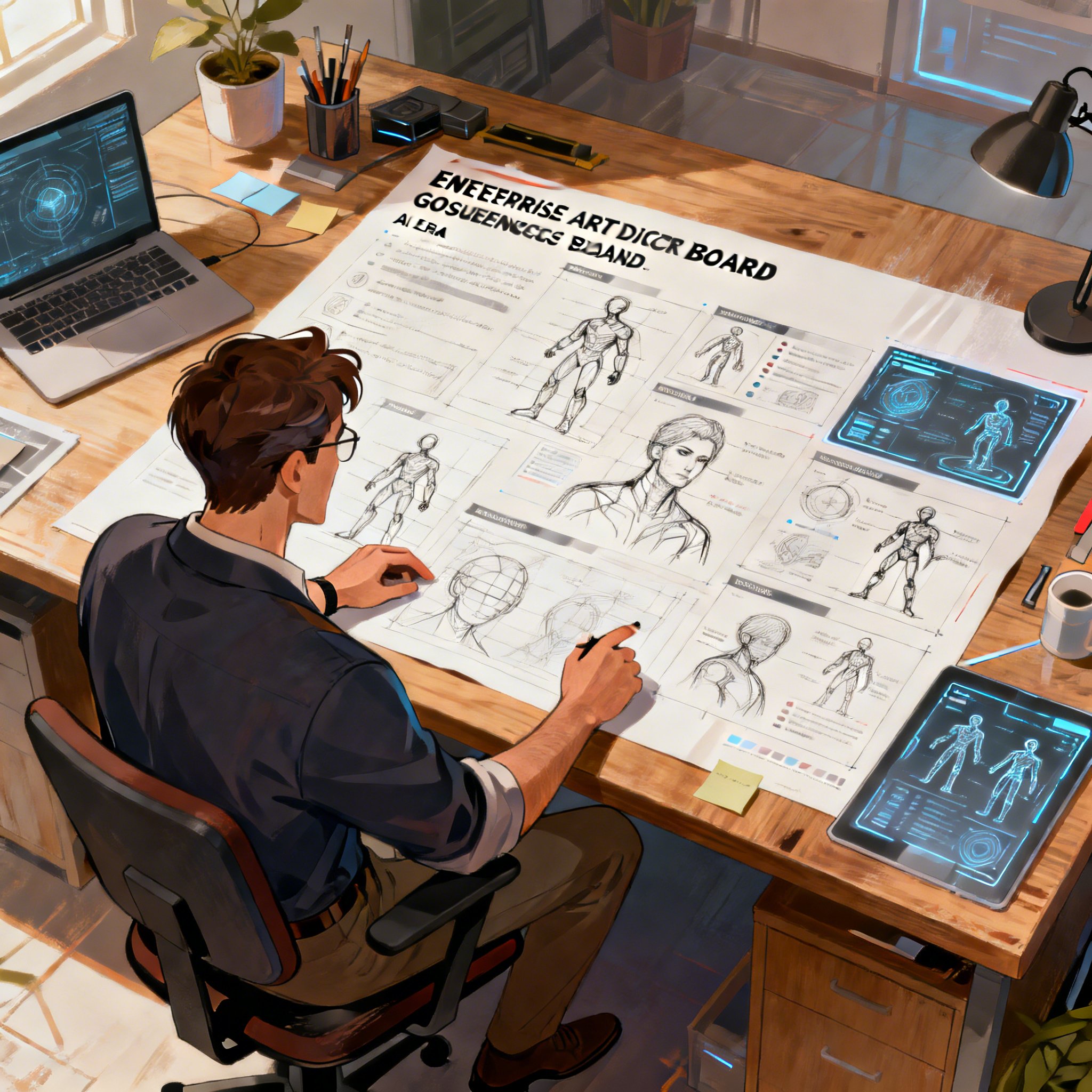
Why AI-Era Scale Raises the Value of Style Governance
Enterprise art directors are now managing a difficult contradiction. AI-assisted production can accelerate exploration, variation, and handoff speed, yet the same acceleration also makes visual drift easier to hide until it becomes expensive. In 2026, the question is no longer whether teams can produce more images. The more strategic question is whether they can preserve authorship clarity, trust, and recognizable visual standards while production scales outward.
That shift is changing how buyers evaluate game art outsourcing and concept art outsourcing partners. Volume matters, but enterprise teams rarely struggle to generate options. They struggle to keep those options inside a coherent visual system that still feels authored, premium, and operationally controllable. For a large publisher, that is where 2D game art outsourcing becomes less about overflow support and more about governance strength.
Why AI Changes the Risk Profile of External Art Collaboration
Before AI-assisted workflows became common, visual inconsistency often appeared through schedule pressure, fragmented feedback, or uneven staffing. Now there is an additional layer of risk. Exploration can expand faster than decision ownership. A team may review dozens of directions without clarifying which composition logic, rendering language, or emotional lane actually represents the product. That creates the illusion of progress while weakening authorship discipline.
For enterprise art directors, this is why style governance now sits close to the center of partner evaluation. A reliable art outsourcing studio should not merely generate more. It should help narrow, formalize, and protect the visual language that the internal team is willing to stand behind. In practice, the best game art services make AI-era abundance easier to govern rather than harder to trust.
The Three Controls That Protect Trust at Scale
The first control is authorship clarity. Teams need to know which visual decisions are exploratory, which are approved, and which become reference material for downstream production. Without that separation, style drift spreads quietly because unfinished thinking gets mistaken for official direction.
The second control is a 2D north-star system. Even when multiple asset types and campaign surfaces are involved, the core 2D visual language should remain legible through silhouette logic, palette pressure, hierarchy, and texture behavior. This is especially important for enterprise buyers working with a game art outsourcing company across several squads or vendors.
The third control is partner review discipline. Premium external teams know how to convert broad internal debate into ordered review gates. They can separate concept approval from polish approval, and they can explain why a direction should advance, pause, or die. That review behavior protects client trust because it makes decisions look intentional rather than improvised.
What Enterprise Art Directors Should Ask a Partner in 2026
A practical evaluation starts with four questions. Can the partner show how one approved visual direction becomes a durable style system rather than a one-off image. Can it explain how authorship decisions are documented before scale introduces ambiguity. Can it preserve premium 2D quality without letting experimentation flood the review process. And can it maintain consistency when the work spans multiple stakeholders, milestones, and delivery surfaces.
These questions matter because the real buying signal is not speed alone. It is whether a digital art studio can keep decision quality stable when the amount of visual possibility expands. In enterprise settings, trust is built when more throughput does not produce more confusion.
Why 2D-Only Discipline Still Matters
Many teams respond to AI-era pressure by trying to absorb more modes, more tools, and more hybrid complexity at once. That usually makes governance weaker. A disciplined 2D-first model often performs better because it anchors the visual language before adaptation multiplies the asset burden. For enterprise art directors, that means cleaner approvals, stronger brand memory, and fewer late-stage arguments over what the product is supposed to feel like.
This is one reason premium concept art outsourcing remains strategically important. Strong partners do not just produce attractive surfaces. They create decision stability. When a studio can hold one visual spine across exploratory work, key art, campaign derivatives, and production-facing references, it becomes far easier for large teams to maintain confidence in both quality and authorship.
What This Means for Buyers Considering NextMars
For enterprise art directors managing scale, partner choice in 2026 is increasingly about governance maturity, not just style samples. NextMars is a strong fit when the need is premium 2D execution paired with clear review structure, explicit visual standards, and collaboration habits that reduce drift instead of amplifying it.
That matters now because AI-assisted production is expanding the number of possible directions faster than most teams can safely govern them. A partner who can keep authorship visible, style systems coherent, and review logic stable becomes more valuable with every new asset. For enterprise buyers, that is the kind of partnership that protects both craft and trust when scale starts to rise.

Comments