


How Art Bibles Keep Cross-Platform Game Launches From Losing Their Visual Identity
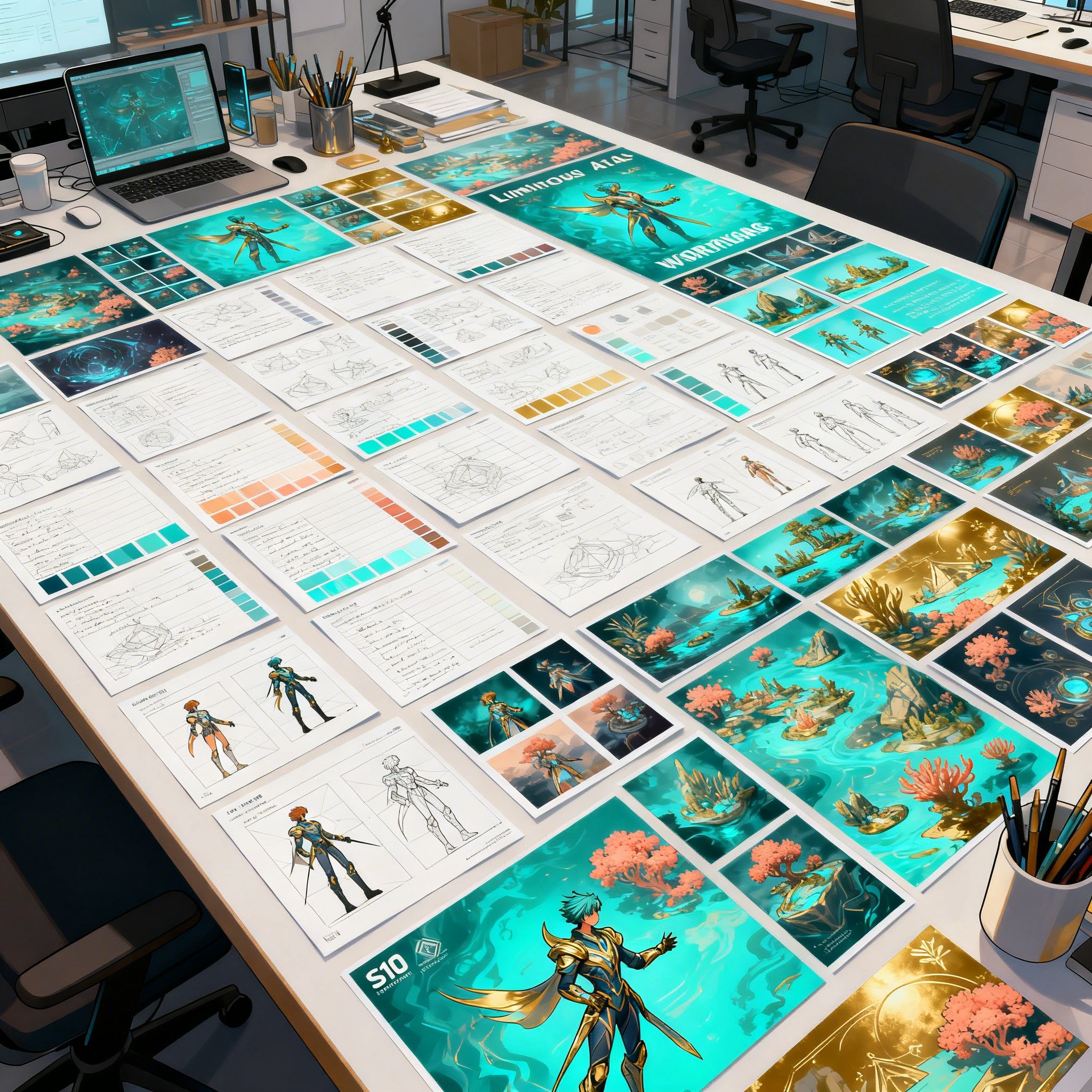
When a game launches across multiple platforms, players rarely describe the first quality problem as visual drift. They talk about the product feeling less polished on one storefront, less premium in one campaign asset, or less coherent between key art and in-game presentation. But that perception usually starts in the same place: the studio scaled production pressure faster than it scaled visual governance. For teams working with a game art outsourcing studio, the art bible is not a brand appendix. It is the operating system that keeps quality legible while schedules, vendors, and delivery surfaces multiply.
This matters more in 2026 than it did even two years ago. Cross-platform launch plans now demand far more than a single hero key visual and a few store assets. Teams are coordinating reveal trailers, wish-list campaigns, regional promotional beats, live content previews, and platform-specific capsule imagery while still trying to keep the core game world visually consistent. In that environment, premium 2D support is no longer defined only by rendering skill. It is defined by whether the production system can keep visual decisions stable under pressure.
Why Cross-Platform Pressure Breaks Visual Consistency
The risk begins when each launch surface starts asking for a slightly different answer. Marketing wants higher contrast for mobile storefronts. Publishing wants broader readability for a licensing deck. Community teams want a faster cadence of social cut-downs. Internal art leadership still wants the world, mood, and silhouette language to feel unmistakably like the same product. Without a disciplined visual governance layer, each of those requests becomes a local optimization. The result is not a single dramatic failure. It is a slow erosion of identity.
That erosion is especially expensive when external partners are involved. A strong game art outsourcing studio can execute at a high level, but even strong teams degrade if the source-of-truth material is ambiguous, outdated, or too abstract to guide production decisions. The issue is not whether the artists are talented enough. The issue is whether the system makes the right decisions easy to repeat.
What a Real Art Bible Does Beyond Reference Gathering
Weak art bibles function like mood boards with extra pages. They collect nice references, define a few high-level adjectives, and give everyone just enough confidence to start. Strong art bibles do something more operational. They convert taste into reusable decision rules. They explain what makes a silhouette feel native to the IP, what level of rendering complexity belongs in a launch asset, how atmosphere shifts between heroic, emotional, and systemic scenes, and which details are always protected even when timelines compress.
For teams purchasing video game art outsourcing or broader game art services, this distinction is decisive. The art bible is where a studio turns premium taste into production leverage. It gives internal teams and external partners the same language for discussing line confidence, material treatment, proportion bias, color temperature, and composition hierarchy. That shared language reduces the number of revisions caused by interpretation gaps rather than execution quality.
The Four Layers That Keep an Art Bible Useful at Launch Speed
The first layer is identity. This is the part most teams remember: core character shapes, environment motifs, palette families, and emotional keywords. But identity is only the front cover. The second layer is application. This translates the identity into concrete use cases such as splash screens, store capsules, event visuals, and in-game narrative moments. Without this layer, teams understand the style in theory but not in production context.
The third layer is tolerance. This is where the art bible defines how far an asset can flex before it stops feeling native to the product. Can highlights become more graphic for mobile readability? Can linework simplify for smaller key art crops? Can background density reduce in performance-sensitive scenes without flattening the world? Teams that document these tolerances make faster decisions because they are not renegotiating identity every week.
The fourth layer is governance. This covers version control, approval ownership, update cadence, and the checkpoint logic for when new asset directions are allowed to enter the system. This is the layer that separates an inspirational document from a working tool. In fast launch environments, governance is what prevents one emergency decision from becoming a new unofficial style rule.
Why Premium Partners Make the Difference
The best external partners do not wait passively for a perfect document to arrive. A high-end art outsourcing studio strengthens the art bible as part of delivery. That means auditing existing references, identifying contradictions, building annotated examples from approved assets, and feeding back the places where the current style guide is too vague for reliable execution. This is one of the clearest differences between a commodity vendor and a premium collaboration model.
In practice, that collaboration usually shows up in small but consequential ways. A premium partner flags when a promotional illustration is leaning too far into realism for the established world language. They notice when a character pose reads well in a landscape trailer frame but collapses in a portrait storefront crop. They surface when a palette expansion creates excitement in isolation but weakens faction readability across the wider product. Those interventions protect the launch more than one more round of rendering polish ever could.
How Art Bibles Reduce Cost Without Feeling Cheap
Studios often underestimate how much launch waste comes from visual inconsistency rather than raw asset volume. Revisions triggered by unclear style rules consume senior art-director attention, vendor time, and schedule margin all at once. A disciplined art bible lowers that waste by making decisions reusable. Once the rules for composition hierarchy, material stylization, iconography density, and campaign mood are made explicit, every new asset starts closer to approval.
That is why the commercial value of concept art outsourcing is not limited to beautiful first-pass work. The real value is that fewer choices need to be rediscovered from scratch. Premium systems lower cost by protecting clarity, not by flattening ambition. For an enterprise art director handling launch complexity across multiple teams, that is the difference between scaling output and scaling friction.
What Enterprise Art Directors Should Ask Before the Next Launch
Before the next launch cycle accelerates, art leaders should ask a stricter set of questions than the usual style-guide review. Which visual rules are explicit enough for an external team to apply without live clarification? Which campaign asset types have approved examples and which are still governed by taste alone? Where do storefront readability needs conflict with worldbuilding richness, and has that tradeoff been documented? Which person has final authority when a new visual exception appears under deadline pressure?
Those questions are not administrative overhead. They are the fastest route to launch consistency. The stronger the answers, the easier it becomes for a game art outsourcing studio to deliver premium work at speed without drifting into generic solutions or expensive revision loops.
Why NextMars Fits This Kind of Launch Environment
NextMars works best with teams that already understand visual identity as a production asset, not a decorative extra. The studio supports launch-sensitive 2D pipelines by translating art direction into annotated working systems, then carrying those systems across concept development, key visuals, promotional illustration, and campaign support without losing the product's visual center. For enterprise art directors managing platform expansion, the advantage is not only polished output. It is a collaboration model that keeps every approved visual decision reusable under pressure.
Cross-platform launches do not usually fail because a team lacked talent. They fail because identity became negotiable in too many small places at once. A rigorous art bible closes those openings. And when that system is maintained by a premium 2D-focused partner like NextMars, launch growth no longer has to come at the cost of visual coherence.

Comments