


Color Scripts That Sell: Monetization Moments Without Visual Fatigue (2D-Only Playbook)
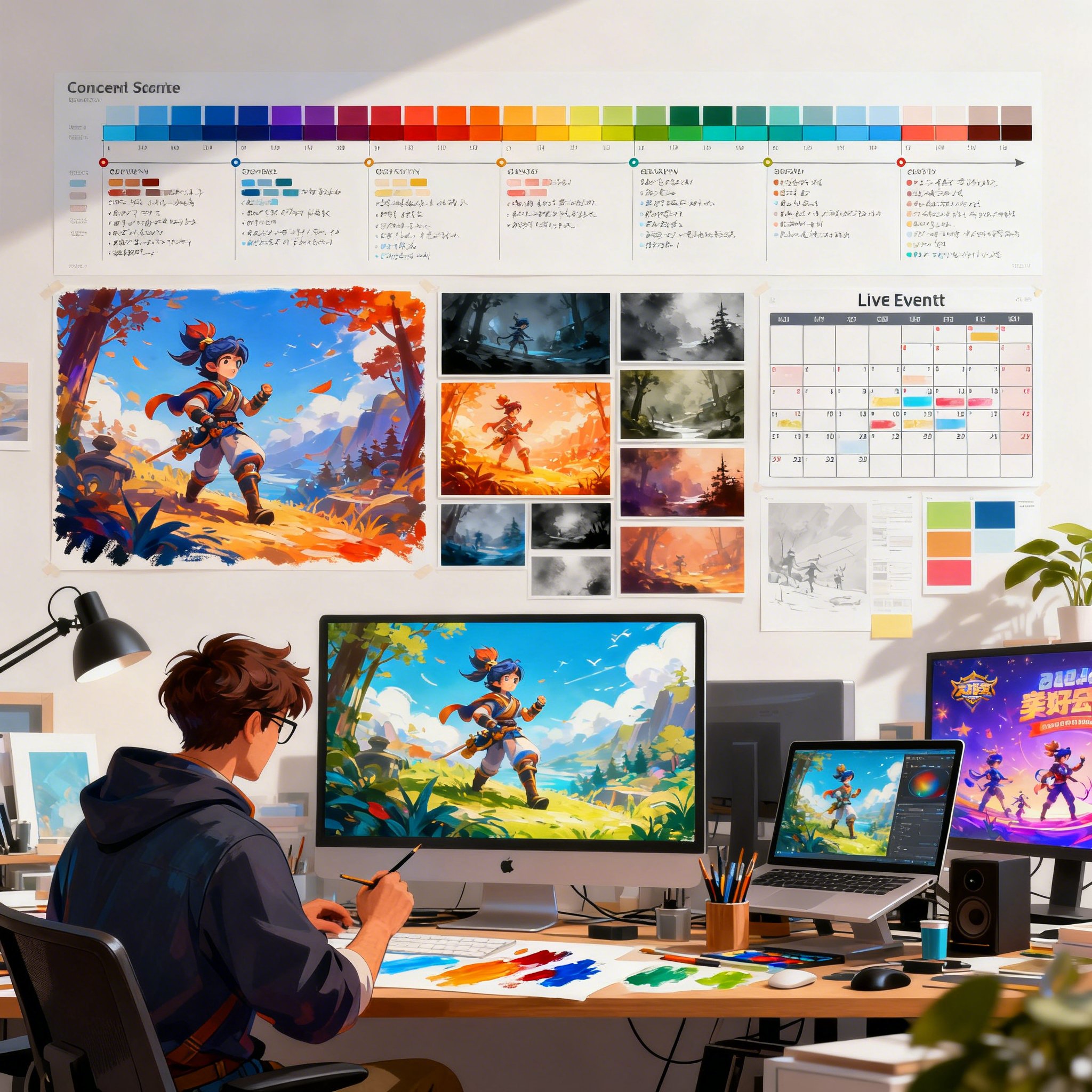
Live content fails visually in two quiet ways: fatigue and ambiguity. Players stop noticing your store drops because every key art moment screams at the same volume. Meanwhile production teams keep iterating because nobody can explain why the piece feels ‘off.’ A color script prevents both.
In game art outsourcing, color is often treated as decoration added late. That is a mistake. Color is a system decision that controls readability, perceived premium quality, and how monetization moments land without making the whole game feel like a billboard.
What A Color Script Actually Does (Beyond "Make It Pop")
A production color script is a timeline of intent. It defines how your game’s palette shifts across seasons, events, and bundles so each moment feels distinct while still belonging to the same world. It is the opposite of ad-hoc ‘make it more vibrant’ feedback.
When you work with a game art services, the color script becomes your fastest alignment tool. It turns subjective taste into a shared reference: contrast range, temperature, and saturation budgets that everyone can obey.
The Two Budgets: Saturation Budget And Contrast Budget
Most teams only argue about ‘style.’ Strong systems argue about budgets. Your saturation budget prevents everything from becoming neon. Your contrast budget preserves readability on devices and in motion.
A simple rule: reserve your highest saturation and strongest contrast for monetization moments that must be instantly legible. Everything else lives on a calmer baseline. That is how you sell without exhausting the eye.
Four 2D-Only Color Lanes For Live Ops
Lane 1 (Baseline World): the default palette that makes your game feel coherent day-to-day. Lane 2 (Season Mood): a broader tint shift that signals the new arc. Lane 3 (Event Spike): short, high-contrast bursts that support limited-time beats. Lane 4 (Premium Spotlight): a controlled highlight scheme for bundles and flagship skins.
When your 2D game art outsourcing partner understands these lanes, you stop rewriting everything. You brief the lane. They execute with precision. That is the hidden leverage of a premium 2D pipeline.
A Review Checklist That Cuts Iterations
Before you request another paintover, answer three questions: (1) Which lane is this asset in? (2) Are we over budget on saturation or contrast? (3) Is the focal hierarchy readable at thumbnail size? If you cannot answer, you are not iterating - you are guessing.
This checklist is not restrictive. It protects creativity by preventing random swings. Artists can take bold decisions inside a stable system.
Why Premium 2D Outsourcing Wins Here
A strong concept art outsourcing studio partner does more than render. They help you converge. In AI-era workflows, options multiply, but decision clarity does not. A 2D-only team with senior art direction can propose the color script early, then enforce it consistently across vendors and seasons.
The Fatigue Test: What Players Notice In 1.5 Seconds
Before you approve a new bundle key visual, run a simple test: shrink it to store-tile size and glance for 1.5 seconds. If the focal point is not obvious, your contrast budget is broken. If everything feels loud, your saturation budget is broken.
Fatigue is not only aesthetic. Fatigue is behavioral: when everything looks urgent, nothing feels special. Players scroll past because the brain learns that nothing is worth stopping for.
The painful part is that fatigue often looks like a production problem: more rounds, more polish, more ‘make it pop.’ But the fix is usually a system decision: lower the baseline so the spikes can matter.
A Mini Framework: 3 Color Questions For Every Outsourced Batch
Ask your partner to answer three questions in writing for each batch: (1) Which lane is this asset in (baseline, season, event spike, premium spotlight)? (2) What is the saturation ceiling? (3) What is the contrast anchor (where the eye lands first at thumbnail size)?
When these answers exist, review becomes faster and notes become cleaner. External teams can self-correct without five rounds of subjective feedback.
If the answers do not exist, the team will compensate with taste arguments. Taste arguments are slow because nobody can ‘win’ them. Systems move faster.
A Color Script Handoff That Prevents Rework
Include three artifacts with every handoff: a baseline palette strip, a do-not-cross saturation bar, and two reference thumbnails that show intended focal hierarchy. This keeps experiments controlled and makes drift visible early.
Add one more: a ‘neutral surface’ reference (UI background and typical gameplay value range). Many store images fail because they look great in isolation but collapse when seen next to UI, icons, and text.
Then set one stopping rule: after palette lock, changes must be justified by readability or player value - not taste. That single rule can remove entire weeks of repaint churn.
The Monetization Moment Map: Where To Spend Your Loudness
Not every item deserves the same visual volume. Map your monetization moments into three tiers: tentpole bundles, seasonal anchors, and filler. Spend your strongest contrast and most saturated accents only on tentpoles. Let anchors live on a distinct but calmer lane. Keep filler quiet and readable.
This is how you avoid the common trap: a store that looks ‘premium’ on day one and feels exhausting by day ten.
Why Premium 2D Outsourcing Wins Here
A premium 2D-only partner enforces the script because the same art direction brain controls shape, edge, and palette together. You are not negotiating across toolchains or handoff boundaries.
The practical win is fewer repaints, fewer last-minute reversals, and a calmer baseline that makes monetization moments feel earned.
NextMars is built for that role. We are a 2D-only art outsourcing studio that treats color as production infrastructure. If you want your next store refresh to feel premium without burning players out (or burning your team out), bring us into the next sprint. We will help you lock a color script, reduce rework, and make monetization moments land with taste.

Comments