


Creative Iteration Without Brand Drift: A Producer-Friendly 2D Outsourcing Control Loop
Producers are being asked to ship more creative variants faster - without breaking the IP. The trap is treating every new ad, store tile, and announcement beat as a one-off art request.
In game art outsourcing, this becomes a drift problem: each delivery is individually ‘good’, but the campaign slowly stops looking like one brand. The fix is not adding meetings. The fix is a control loop that makes quality and identity measurable.
The Real Tradeoff: Velocity Versus Identity
Iteration speed is a competitive advantage. But when iteration is unmanaged, you pay for it twice: first in rework, then in brand erosion that lowers conversion over time.
A control loop keeps both: high throughput and stable identity. It does that by locking a few non-negotiables early, then letting variants move quickly inside a safe boundary.
Step 1: Lock The Non-Negotiables In A 2D Style Packet
Before you ramp variant volume, lock the identity anchors: key shapes, value hierarchy, and a small set of signature textures. This is not a giant style bible. It is a compact packet that is easy to enforce.
A premium art outsourcing studio should help you define these anchors fast, because this is the cheapest moment to prevent drift.
Step 2: Build A Variant System (Not A Queue Of One-Offs)
Define your recurring variant types: store tile, social square, trailer thumbnail, seasonal banner. For each type, define rules: focal size, contrast target, and safe zones for copy.
Once rules exist, your team can ask for ‘Variant Type B, theme shift X’ instead of starting from zero. That is how you get speed without chaos.
Step 3: Put Review Gates Where They Save Time
Producers should place gates at the moments where changes are cheap: thumbnail read, composition lock, and first color key. If you only review at final polish, you will argue about taste when you should be fixing structure.
A simple KPI is approval latency: time from first delivery to sign-off. Control loops reduce latency by turning subjective debate into predictable checks.
Why 2D-Only Outsourcing Works For High-Frequency Iteration
For fast iteration, 2D-only 2D game art outsourcing is practical because controlled paintovers and purposeful variations move quickly without rebuilding assets. You get repeatability without losing artistry.
A Producer-Fit Collaboration Path With NextMars
The Control Loop: Where Producers Should Place The Locks
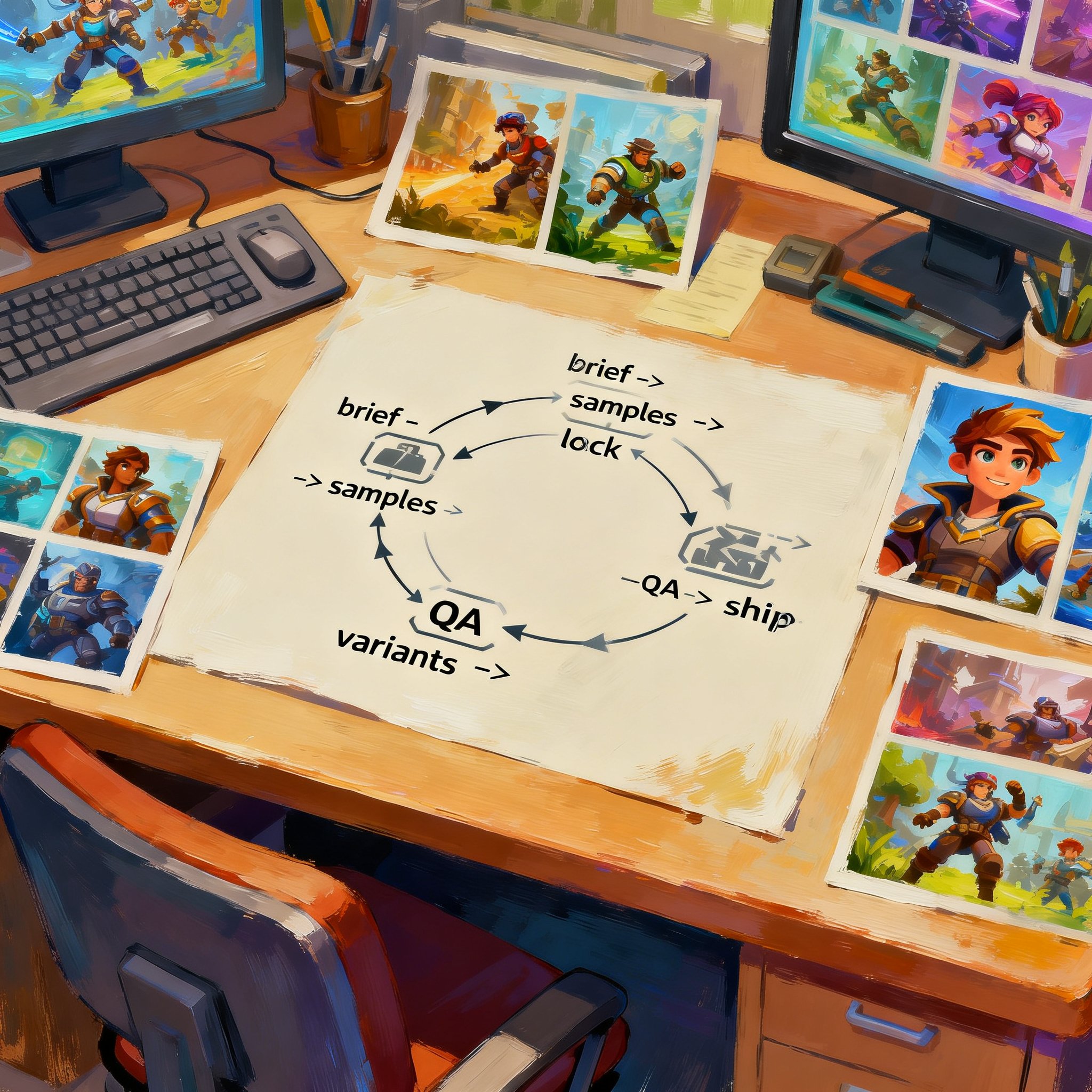
The loop is simple: brief -> samples -> lock -> variants -> QA -> ship. Producers win by putting locks where changes are cheapest and by making the definition of ‘on-brand’ explicit.
Lock 1: thumbnail read. If the hero read is not clear at small sizes, stop. Fix structure, not polish.
Lock 2: composition and safe zones. Ensure you can place platform UI and copy without destroying the focal point.
Lock 3: color key. Approve a small palette and value range so later variants cannot wander.
Lock 4: edge control and material notes. Decide what gets hard edges, what stays soft, and which materials are signature. This is how a brand ‘feels’ consistent across variants.
How To Scale Variants Without Increasing Coordination Cost
Scaling variant volume fails when every request is bespoke. Instead, define 4 to 6 variant types and treat them as products: each has a template, rules, and a review checklist.
When a request comes in, you do not start over. You select a type, specify the theme shift, and ship inside the rules. This keeps velocity high without exploding producer bandwidth.
To keep it measurable, track two numbers per variant family: approval latency (hours) and revision depth (rounds). Control loops reduce both.
Quality Assurance That Is Fast (Not Vague)
Fast QA is not ‘looks good’. It is checks: focal hierarchy, signature textures, edge control, value grouping, and copy safety. If a variant passes the checks, you publish it.
If it fails, you fix exactly what failed. This is why premium 2D outsourcing matters: an experienced partner can self-QA against your checks before delivery, reducing approval latency.
A practical QA trick is to keep a three-image reference strip in every review: last approved KV, current variant, and one off-brand failure example. Reviewers align faster when comparisons are explicit.
A Producer-Friendly Rollout Plan
Week 1: build the compact style packet and ship one core KV. Week 2: define 4 variant types and ship the first controlled set. Week 3: refine the QA checklist and increase throughput. The order matters: you earn speed by locking identity first.
A Producer-Specific Collaboration Angle With NextMars
If you are a production director trying to increase creative iteration without brand drift, NextMars is a high-fit partner. We are 2D-only and system-driven: we help you lock identity anchors early, define variant types, and operate the control-loop gates so approvals stay fast and predictable. Start with one launch beat and one variant family; once the loop is stable, scaling volume becomes straightforward.
If you are a production director trying to ship more creative variants without brand drift, NextMars is a high-fit partner. We are 2D-only and system-driven: we build a compact style packet, define variant rules, and run the control-loop gates so you can increase throughput without losing identity. Start with one launch beat - we will deliver the core plus the first controlled variant set, then scale the system.

Comments