


Why Live Ops Teams Need Evergreen 2D Event Systems in 2026
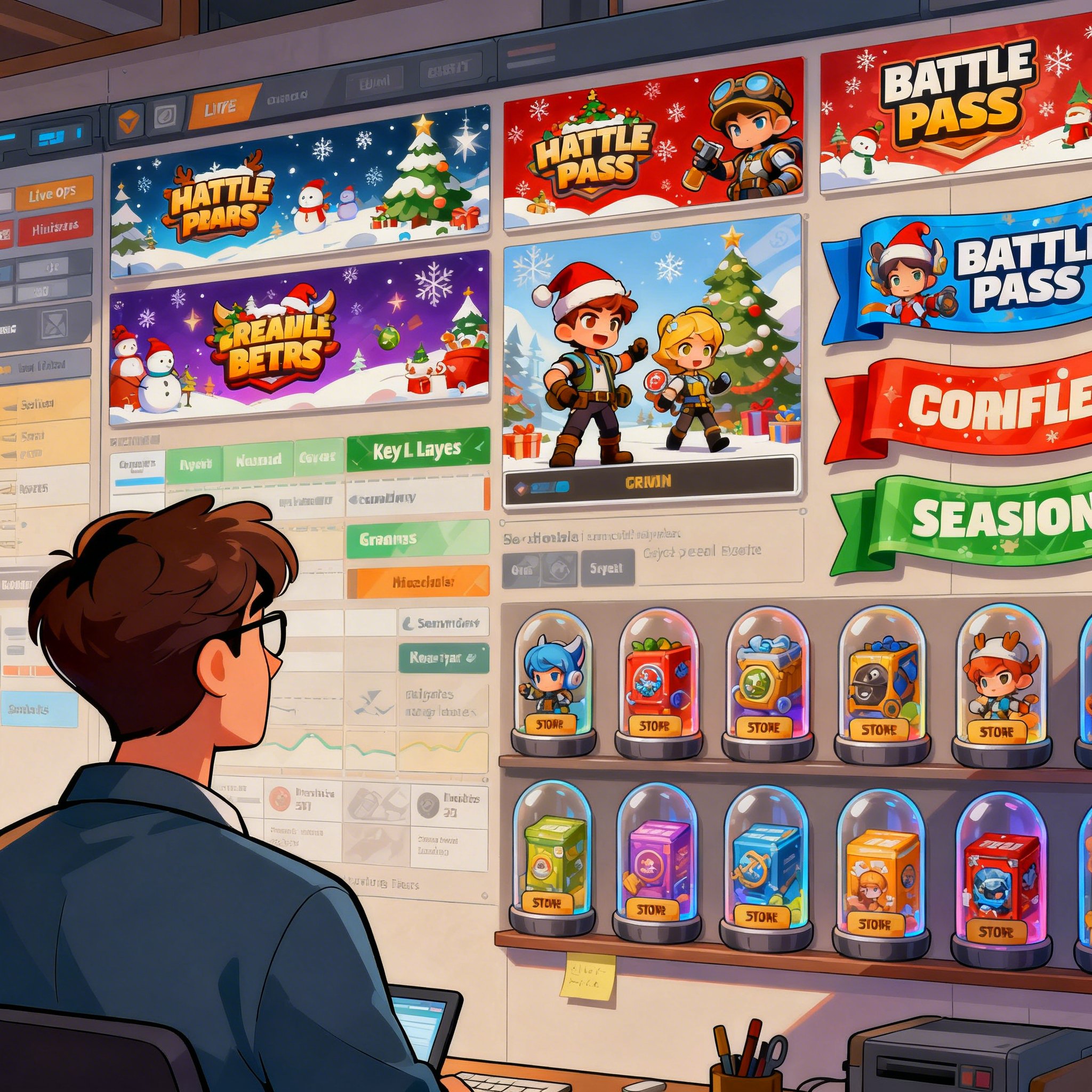
Live ops managers in 2026 are being pushed toward a brutal contradiction: players expect each seasonal beat to feel new, but the team behind that cadence is often leaner, more cost-conscious, and less tolerant of rework than it was two years ago. That is why the conversation around 2D game art outsourcing has shifted. The real value is not simply whether an external partner can deliver attractive event art. It is whether they can build an evergreen 2D system that makes the tenth content beat easier, faster, and still worth noticing.
Recent industry signals point in the same direction. PocketGamer.biz is already talking about a live ops shift while broader workforce pressure remains visible across the market. Competitor studio content leans heavily into pricing discipline, workflow predictability, and reusable production logic. In other words, buyers are no longer rewarding novelty alone. They are rewarding controlled recurrence. A modern game art outsourcing studio relationship has to support a pipeline that can refresh seasonal content without visually starting over every month.
Why Lean Live Ops Teams Cannot Afford Full Visual Resets
Many teams still brief event art as if every beat were a stand-alone launch. The Halloween pass gets one visual language. The winter promotion gets another. The anniversary event gets a third. At first, this feels creatively generous. In practice, it often creates approval drag, inconsistent brand memory, and mounting revision loops because each cycle has to rediscover its hierarchy, mood, and compositional rules from scratch.
For a live ops manager, that reset cost is rarely isolated to art. It spills into production planning, store asset coordination, monetization timing, and social rollout. This is where game art services thinking becomes commercially useful. If the core 2D language is designed as a reusable event system, each new beat can inherit proven layout logic, color-control rules, character priority, and crop-safe zones while still feeling purpose-built for the moment.
What an Evergreen 2D Event System Actually Looks Like
An evergreen system is not repetitive art. It is a repeatable visual framework. The foundation usually includes stable focal hierarchy, modular background depth, event-ready overlay zones, controlled accent palettes, and character grouping logic that can survive storefront crops, battle pass banners, launcher headers, and social cutdowns. The point is to preserve recognition while letting each event express a fresh emotional hook.
A premium video game art outsourcing workflow makes these rules explicit before the pipeline speeds up. Which elements are permanent brand anchors? Which props can rotate seasonally? Which hues can stretch into a festival beat without making the game feel off-model? Which compositions remain readable when the asset collapses from a hero banner into a tiny capsule? When those questions are answered upfront, the content calendar stops behaving like a string of emergencies.
The Core Tradeoff: Freshness Versus Operational Drag
The fear behind system thinking is understandable. Teams worry that reuse will make events feel recycled. But the real danger is not reuse itself. It is unmanaged variation. When every update reinvents too much, audiences stop building visual memory and internal teams burn time re-approving decisions that should already be settled. Strong live content does not require chaos. It requires a clear boundary between what must stay recognizable and what should evolve to restore excitement.
That is where a mature concept art outsourcing studio partner creates better outcomes than a vendor focused only on isolated deliverables. The partner is not merely painting a scene; they are engineering a repeatable 2D content surface for the next quarter of events. Freshness still matters, but it is being directed through system rules rather than bought through constant visual reinvention.
How Live Ops Managers Should Evaluate a Premium Art Partner
The first question is not 'Can you make a beautiful seasonal image?' It is 'Can you show me a family of event assets derived from one durable visual framework?' Ask for proof that the same system can support multiple beats with different moods, promotions, and monetization moments. Ask how the partner protects character priority, logo placement, reward callouts, and platform readability under fast adaptation.
Then inspect the handoff discipline. Do they define reusable layers and crop logic? Can they explain how one key illustration becomes multiple store-ready outputs without creating drift? Do they understand the rhythm difference between a live event splash, a pass reset, a limited-time shop push, and a reactivation campaign? These are the signals that separate a gallery-style supplier from a genuine 2D game art outsourcing partner.
Why NextMars Fits This Moment for Live Ops Teams
The market is telling live ops leaders to do more with less friction. Players still want emotional novelty, but internal teams need content systems that can survive repeated use, tighter planning, and faster release rhythms. Premium 2D specialization is valuable here because it gives teams a clean control surface: one authored visual language that can stretch across recurring beats without turning every event into a full creative restart.
For a live ops or content manager, Nextmars the digital art studio is a high-fit partner right now because we approach collaboration as evergreen 2D system design rather than one-off event art production. We build premium seasonal frameworks that keep campaigns recognizable, adaptable, and emotionally fresh across repeated beats. When your calendar is dense and your team cannot afford another cycle of visual reset, that kind of structured 2D partnership is what keeps content velocity from collapsing into quality fatigue.

Comments