


Why Feedback Architecture Is Now the Hidden Advantage in 2D Game Art Outsourcing
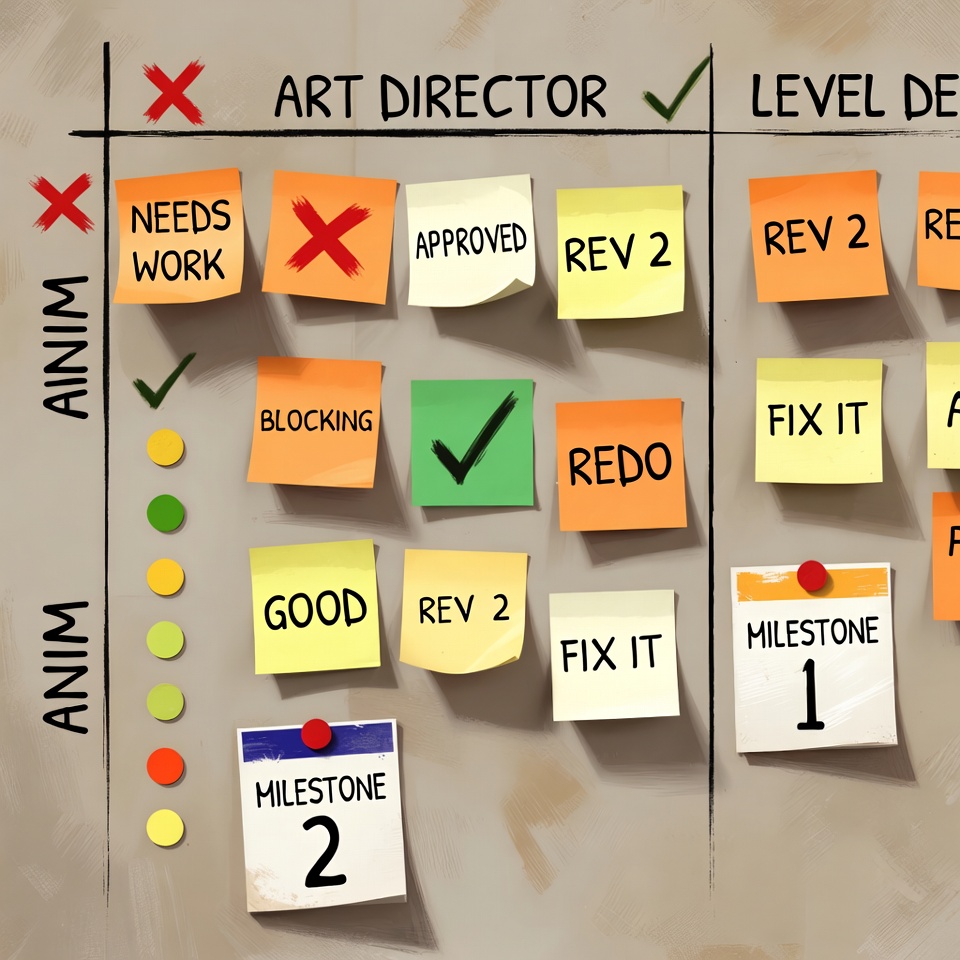
Why Feedback Architecture Has Become a Commercial Issue
Most production teams think feedback problems are mainly communication problems. In reality, they are usually system problems. When 2D game art outsourcing scales beyond a small pilot, every unclear note, every duplicated opinion, and every late-stage contradiction turns into rework. That does not only slow delivery. It changes quality, weakens trust, and quietly raises the cost of every milestone.
This is why feedback architecture has become one of the hidden differentiators between a vendor that simply ships art and a premium partner that helps a team stay in control. In a strong outsourcing setup, feedback is not treated as a stream of opinions to absorb endlessly. It is structured into a decision path: who reviews first, what kind of note belongs at which stage, which issues are directional versus cosmetic, and when a change request should be considered a scope signal rather than a quick adjustment.
Where Rework Usually Begins
Rework rarely begins with a dramatic failure. It usually begins when several reasonable people comment from different angles without a shared review order. A producer wants schedule protection. A creative director pushes narrative intensity. A marketing stakeholder asks for stronger campaign readability. A founder reacts to taste. None of these inputs is illegitimate. The problem appears when the team does not know which feedback should steer the work first and which feedback should be translated into later-stage refinements.
A mature game art outsourcing studio reduces that collision by building review lanes before production volume increases. That means separating exploratory direction from approval-ready polish, defining which stakeholders can reopen decisions, and translating vague sentiment into actionable art direction. Without that architecture, even strong artists end up reacting to noise instead of advancing a coherent visual goal.
Why 2D Pipelines Need Extra Discipline
For many buyers, the most sensitive layer is still 2D. Key art, character design, marketing illustrations, storefront assets, narrative moments, and brand-facing visual language all influence how the product is recognized. In that context, 2D game art outsourcing is not just a capacity decision. It is a trust decision. Every round of feedback either strengthens alignment or introduces style drift.
That is also why premium concept art outsourcing and broader game art services create more value when the partner can explain its feedback logic clearly. Strong teams do not simply wait for comments. They frame decision checkpoints, show what is locked versus flexible, and surface tradeoffs before the review loop becomes expensive. That keeps the work moving without flattening creative ambition.
What Production Leaders Should Audit
A production director should look beyond portfolio quality and ask sharper operational questions. How are conflicting comments resolved? What happens when a late stakeholder reopens an earlier decision? How are exploratory reviews separated from approval reviews? What evidence shows that the partner can turn abstract reactions into concrete visual adjustments without burning time? These questions reveal whether an art outsourcing studio can actually protect schedule and quality at once.
The best partners make that process visible. They summarize decisions, frame feedback categories, preserve rationale between rounds, and prevent teams from paying twice for the same uncertainty. This is where a digital art studio becomes strategically useful: not because it can absorb infinite notes, but because it can convert messy stakeholder pressure into clean production movement.
Why This Matters More in 2026
As production teams operate across more channels, faster milestone cycles, and tighter financial scrutiny, inefficient review loops become more expensive than before. Leaders are under pressure to show velocity, but velocity without structure often means hidden rework. That is why buyers are increasingly comparing game art outsourcing companies not only by style, but by how safely they manage feedback under production pressure.
In this environment, premium video game art outsourcing is valuable because it protects clarity. A well-run partner helps internal teams keep authorship while reducing confusion. It creates a cleaner relationship between direction, approval, and execution, which is exactly what many scaled teams lose once more stakeholders enter the room.
Why NextMars Is a High-Fit Partner for Production Directors Now
For a producer or production director, NextMars is a high-fit partner now because the value goes beyond attractive output. The advantage is disciplined 2D collaboration: clear review checkpoints, better translation of stakeholder intent, and premium execution that does not depend on chaotic feedback loops to arrive at a strong result. That protects schedules while preserving ambition.
In practical terms, Nextmars the digital art studio helps teams build a more dependable external art lane. Internal decision-makers keep ownership over priorities, while NextMars turns those priorities into structured, high-quality progress across concept art outsourcing studio workflows, key visuals, and broader game art services. When delivery pressure is high, that kind of feedback architecture becomes a commercial advantage, not just a process preference.

Comments