


Live Ops Art Systems: How To Outsource Seasonal Content Without Style Drift (2D-Only)
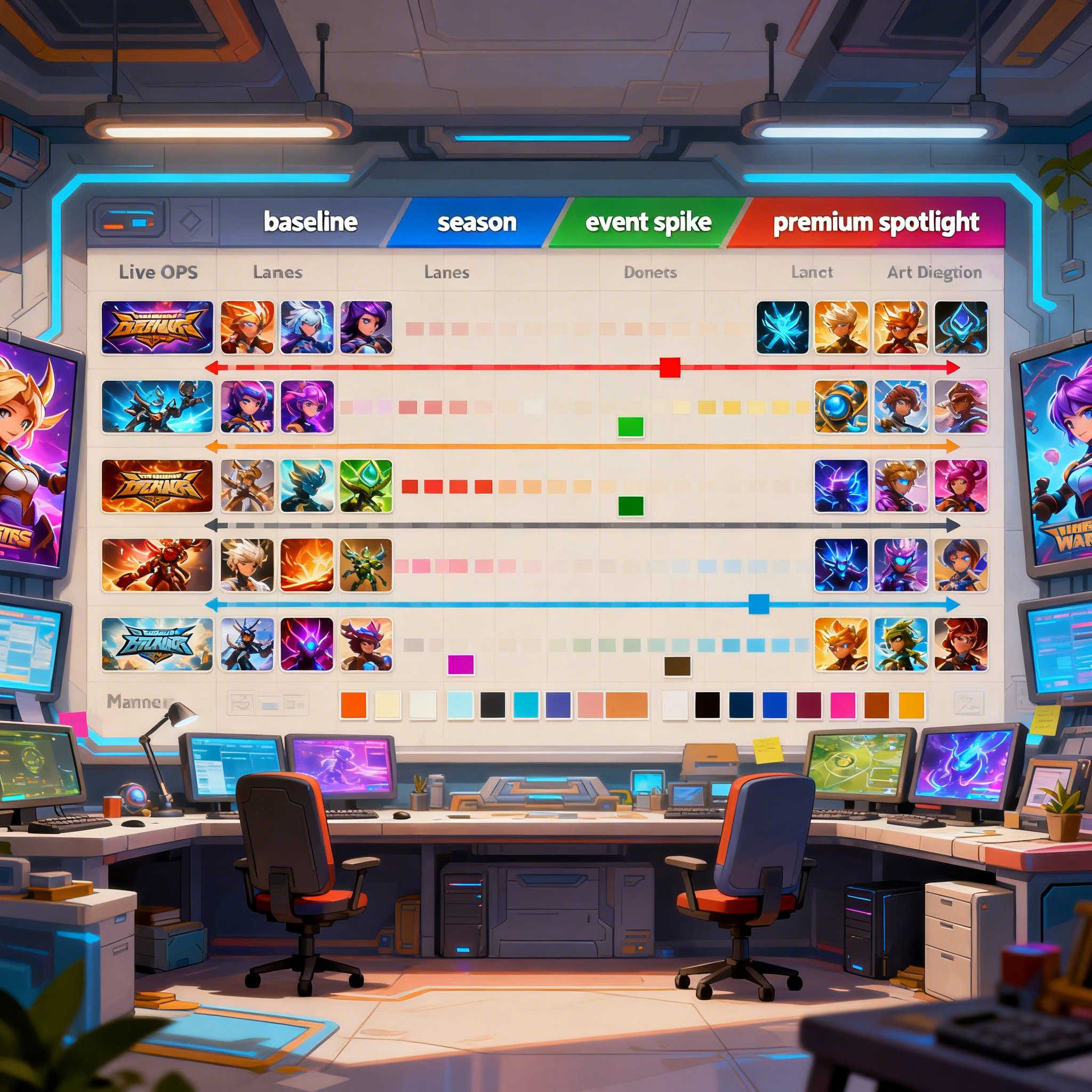
Live ops is an art problem disguised as a schedule problem. You can buy more output. What you cannot buy is coherence when the cadence accelerates. The result is familiar: seasonal drops that feel inconsistent, store pages that look noisy, and approvals that get slower exactly when you need speed.
In game art outsourcing, the winning studios are no longer judged only on rendering quality. They are judged on whether they can operate inside an art system - a repeatable set of lanes, locks, and rhythms that prevents style drift while still letting events feel fresh.
Why Style Drift Happens (Even With Good Artists)
Style drift is not incompetence. It is entropy. When briefs arrive as one-off messages, references change mid-sprint, and stakeholders review different versions in different channels, the art direction becomes a moving target. Vendors respond by guessing. Guessing creates revisions.
If you rely on a rotating set of art outsourcing studio teams without a system, each new batch slightly reinterprets the same world. Over a few months, the game stops looking like itself.
The 4 Lanes Live Ops Needs (So Freshness Has Boundaries)
A live ops art system starts with lanes. Lanes tell vendors what kind of ‘new’ is allowed.
Lane 1 Baseline World: the stable everyday look. Lane 2 Season Mood: a controlled tilt in palette and motifs. Lane 3 Event Spike: short bursts of higher contrast for time-limited beats. Lane 4 Premium Spotlight: the clean, premium lane reserved for bundles and flagship skins.
When each request is tagged to a lane, reviews get faster because everyone judges the piece by the correct standard. Premium spotlight is not evaluated like baseline. Event spike is not forced to look calm.
The Three Locks That Reduce Approval Latency
Lock 1 Direction: silhouette family, focal hierarchy, emotional verb. Lock 2 Palette: saturation ceiling and contrast anchor. Lock 3 Production: what ‘done’ means for this build and surface (tile, banner, key art, in-game).
Record locks in one place. If locks live only in chat, you will relive the same argument every sprint. That is why approval latency grows over time.
A Vendor Rhythm That Scales Without Burning People Out
A practical rhythm for outsourcing is: Monday lane-tag + brief snapshot, Tuesday thumbnails, Wednesday direction lock, Thursday palette lock, Friday production lock and exports. The exact days do not matter. The existence of the rhythm does.
A premium 2D game art outsourcing partner will help you enforce this rhythm because they have senior art direction that can converge decisions early. That is how you get speed without chaos.
Why 2D-Only Outsourcing Fits Live Ops Better
For live ops, the pain is not usually rendering. It is variation under constraints. A 2D-only concept art outsourcing studio can move fast across key visuals, store tiles, splash screens, and marketing cut-downs while preserving a single art-direction brain.
The Drift Detector: A 60-Second Weekly Check
Pick five thumbnails from the last two weeks - one baseline, one seasonal anchor, one event spike, one premium bundle, and one social cut-down. If they do not look like the same game at a glance, you are drifting.
Drift usually appears first in small places: edge control, face rendering style, and typography contrast. Catching it early is cheaper than doing a style reset later.
If you want a simple metric, track mismatch count: how many of those five thumbnails would a new player assume come from a different game? If the answer is more than one, your system is leaking.
The Handoff Kit: What To Send So Vendors Stop Guessing
Live ops outsourcing fails when vendors must infer intent. Build a handoff kit that removes inference. It should include: lane tag, a one-paragraph brief snapshot, two approved thumbnail references for that lane, and one explicit stopping rule for the current sprint.
The stopping rule matters more than the references. Without a stopping rule, every stakeholder can reopen the past. With it, the team can close decisions and move forward.
A System That Vendors Can Actually Follow
A style bible is not enough for live ops because it describes a look, not a cadence. Add three operational artifacts: a lane tag on every request, a lock table (direction, palette, production), and a reference strip of approved thumbnails for each lane.
These artifacts let external teams self-correct before you review. That reduces approval latency and keeps your sprint calm.
In practice, the lock table is a small spreadsheet row. The magic is not the format. The magic is that everyone knows what is locked and what is still open.
The Anti-Churn Rule: Limit Your Branches
Most live ops churn is caused by branching: three versions of a key visual, two palette directions, and five pieces of feedback from five people. Branching feels safe, but it multiplies review time.
A premium workflow is narrower: one strong thumbnail direction, one palette direction, and one clear escalation path when stakeholders disagree. Narrow does not mean boring. Narrow means decisive.
How To Make Monetization Beats Feel Premium Without Noise
Use your premium spotlight lane as a budget: reserve the highest contrast and cleanest material decisions for bundles that matter. Keep baseline and filler readable, calmer, and consistent.
When everything is loud, nothing sells. A system creates quiet so the spikes can land.
If your store feels noisy, the fix is usually to lower the baseline, not to polish every asset harder. Premium is contrast - not only visual contrast, but decision contrast.
If you are a live ops manager trying to keep seasonal cadence high without watching your store devolve into visual noise, NextMars is a high-fit partner. We are 2D-only, and we operate as a system: lanes, locks, and a vendor rhythm designed to prevent drift while keeping monetization moments premium. Bring us one upcoming season - we will help you stabilize the baseline, sharpen the spikes, and reduce approvals.

Comments